 Add to Chrome
 Add to Firefox
 Add to Edge
Why LLMs Hallucinate on Structured Knowledge: A Mechanistic Analysis of Reasoning over Linearized Representations
May 25, 2026
In many reasoning tasks, large language models (LLMs) rely on structured external knowledge, such as graphs and tables, which is typically linearized into sequential token representations. However, even when sufficient knowledge is available, LLMs can still produce hallucinated outputs, and the underlying mechanisms behind such failures remain poorly understood. We investigate these mechanisms and find that hallucinations arise from systematic internal dynamics rather than random noise. First, attention disproportionately concentrates toward shortcut-like structural cues rather than distributing across the full context. Second, feed-forward representations fail to ground the provided knowledge, causing the model to revert to parametric memory. Moreover, our results indicate that hallucination is consistently associated with failures in semantic grounding within feed-forward layers, while attention allocation exhibits greater task-dependent variability. Finally, we show that these mechanistic patterns generalize beyond single-hop graphs to multi-hop and tabular settings, enabling effective hallucination detection across structured knowledge formats.

Resolving Action Bottleneck: Agentic Reinforcement Learning Informed by Token-Level Energy
May 14, 2026Agentic reinforcement learning trains large language models using multi-turn trajectories that interleave long reasoning traces with short environment-facing actions. Common policy-gradient methods, such as PPO and GRPO, treat each token in a trajectory equally, leading to uniform credit assignment. In this paper, we critically demonstrate that such uniform credit assignment largely misallocates token-level training signals. From an energy-based modeling perspective, we show that token-level training signals, quantified by their correlations with reward variance of different rollouts sampled from a given prompt, concentrate sharply on action tokens rather than reasoning tokens, even though action tokens account for only a small fraction of the trajectory. We refer to this phenomenon as the Action Bottleneck. Motivated by this observation, we propose an embarrassingly simple token reweighting approach, ActFocus, that downweights gradients on reasoning tokens, along with an additional energy-based redistribution mechanism that further increases the weights on action tokens with higher uncertainty. Across four environments and different model sizes, ActFocus consistently outperforms PPO and GRPO, yielding final-step gains of up to 65.2 and 63.7 percentage points, respectively, without any additional runtime or memory cost.
When Users Change Their Mind: Evaluating Interruptible Agents in Long-Horizon Web Navigation
Apr 01, 2026As LLM agents transition from short, static problem solving to executing complex, long-horizon tasks in dynamic environments, the ability to handle user interruptions, such as adding requirement or revising goals, during mid-task execution is becoming a core requirement for realistic deployment. However, existing benchmarks largely assume uninterrupted agent behavior or study interruptions only in short, unconstrained language tasks. In this paper, we present the first systematic study of interruptible agents in long-horizon, environmentally grounded web navigation tasks, where actions induce persistent state changes. We formalize three realistic interruption types, including addition, revision, and retraction, and introduce InterruptBench, a benchmark derived from WebArena-Lite that synthesizes high-quality interruption scenarios under strict semantic constraints. Using a unified interruption simulation framework, we evaluate six strong LLM backbones across single- and multi-turn interruption settings, analyzing both their effectiveness in adapting to updated intents and their efficiency in recovering from mid-task changes. Our results show that handling user interruptions effectively and efficiently during long-horizon agentic tasks remains challenging for powerful large-scale LLMs. Code and dataset are available at https://github.com/HenryPengZou/InterruptBench.
Actor-Curator: Co-adaptive Curriculum Learning via Policy-Improvement Bandits for RL Post-Training
Feb 24, 2026Post-training large foundation models with reinforcement learning typically relies on massive and heterogeneous datasets, making effective curriculum learning both critical and challenging. In this work, we propose ACTOR-CURATOR, a scalable and fully automated curriculum learning framework for reinforcement learning post-training of large language models (LLMs). ACTOR-CURATOR learns a neural curator that dynamically selects training problems from large problem banks by directly optimizing for expected policy performance improvement. We formulate problem selection as a non-stationary stochastic bandit problem, derive a principled loss function based on online stochastic mirror descent, and establish regret guarantees under partial feedback. Empirically, ACTOR-CURATOR consistently outperforms uniform sampling and strong curriculum baselines across a wide range of challenging reasoning benchmarks, demonstrating improved training stability and efficiency. Notably, it achieves relative gains of 28.6% on AIME2024 and 30.5% on ARC-1D over the strongest baseline and up to 80% speedup. These results suggest that ACTOR-CURATOR is a powerful and practical approach for scalable LLM post-training.
Detecting Hallucinations in Graph Retrieval-Augmented Generation via Attention Patterns and Semantic Alignment
Dec 09, 2025Graph-based Retrieval-Augmented Generation (GraphRAG) enhances Large Language Models (LLMs) by incorporating external knowledge from linearized subgraphs retrieved from knowledge graphs. However, LLMs struggle to interpret the relational and topological information in these inputs, resulting in hallucinations that are inconsistent with the retrieved knowledge. To analyze how LLMs attend to and retain structured knowledge during generation, we propose two lightweight interpretability metrics: Path Reliance Degree (PRD), which measures over-reliance on shortest-path triples, and Semantic Alignment Score (SAS), which assesses how well the model's internal representations align with the retrieved knowledge. Through empirical analysis on a knowledge-based QA task, we identify failure patterns associated with over-reliance on salient paths and weak semantic grounding, as indicated by high PRD and low SAS scores. We further develop a lightweight post-hoc hallucination detector, Graph Grounding and Alignment (GGA), which outperforms strong semantic and confidence-based baselines across AUC and F1. By grounding hallucination analysis in mechanistic interpretability, our work offers insights into how structural limitations in LLMs contribute to hallucinations, informing the design of more reliable GraphRAG systems in the future.
A Survey on Large Language Model based Human-Agent Systems
May 01, 2025Recent advances in large language models (LLMs) have sparked growing interest in building fully autonomous agents. However, fully autonomous LLM-based agents still face significant challenges, including limited reliability due to hallucinations, difficulty in handling complex tasks, and substantial safety and ethical risks, all of which limit their feasibility and trustworthiness in real-world applications. To overcome these limitations, LLM-based human-agent systems (LLM-HAS) incorporate human-provided information, feedback, or control into the agent system to enhance system performance, reliability and safety. This paper provides the first comprehensive and structured survey of LLM-HAS. It clarifies fundamental concepts, systematically presents core components shaping these systems, including environment & profiling, human feedback, interaction types, orchestration and communication, explores emerging applications, and discusses unique challenges and opportunities. By consolidating current knowledge and offering a structured overview, we aim to foster further research and innovation in this rapidly evolving interdisciplinary field. Paper lists and resources are available at https://github.com/HenryPengZou/Awesome-LLM-Based-Human-Agent-System-Papers.
GLIP-OOD: Zero-Shot Graph OOD Detection with Foundation Model
Apr 29, 2025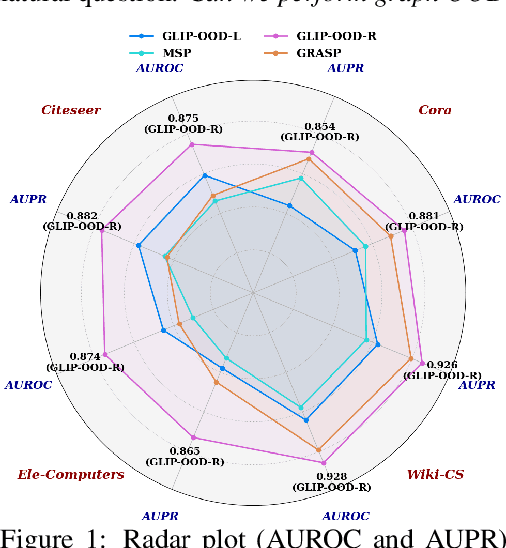
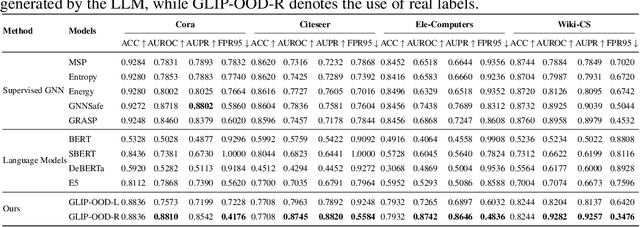
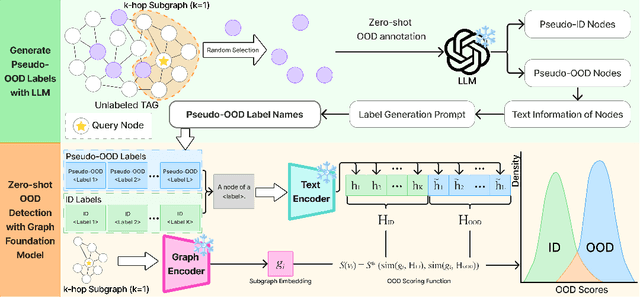

Out-of-distribution (OOD) detection is critical for ensuring the safety and reliability of machine learning systems, particularly in dynamic and open-world environments. In the vision and text domains, zero-shot OOD detection - which requires no training on in-distribution (ID) data - has made significant progress through the use of large-scale pretrained models such as vision-language models (VLMs) and large language models (LLMs). However, zero-shot OOD detection in graph-structured data remains largely unexplored, primarily due to the challenges posed by complex relational structures and the absence of powerful, large-scale pretrained models for graphs. In this work, we take the first step toward enabling zero-shot graph OOD detection by leveraging a graph foundation model (GFM). We show that, when provided only with class label names, the GFM can perform OOD detection without any node-level supervision - outperforming existing supervised methods across multiple datasets. To address the more practical setting where OOD label names are unavailable, we introduce GLIP-OOD, a novel framework that employs LLMs to generate semantically informative pseudo-OOD labels from unlabeled data. These labels enable the GFM to capture nuanced semantic boundaries between ID and OOD classes and perform fine-grained OOD detection - without requiring any labeled nodes. Our approach is the first to enable node-level graph OOD detection in a fully zero-shot setting, and achieves state-of-the-art performance on four benchmark text-attributed graph datasets.